Skip to content
Menu
  • Home
    • About
    • ICIWorld Welcome
    • Make An Appointment
    • Privacy Policy
  • Search
    • Commercial Real Estate
    • Business Opportunity
    • Residential
    • FSBOs (For Sale By Owner)
    • Financing
    • Executive Members
    • BETA
    • Ontario Industrial, Commercial and Investment (ICI) Real Estate
  • For The Public
    • Install the free app
    • Weekly Newsletter
    • For The Public
    • Add Haves Wants FREE
  • Log In Member Management
    • Log In Member Management
    • ICIWorld 100% Scorecard — Are You Maximizing Your Opportunities to Make Money?
  • For Real Estate Brokers & Salespeople
    • For Real Estate Brokers and Salespeople. Get Your Information To Do The Work
  • Blog
  • Social
    • Social and Networking Opportunities
    • Install the Free Real Estate App. Search Daily.
    • Subscribe Weekly Newsletter
    • Subscribe Province/State EMail List Servers
  • For Members
    • For Real Estate Brokers and Salespeople – Put Your Information To Work
    • Free for life memberships.
    • Retired Brokers
    • Referral Brokers
    • Add IDX Links to Your Website
    • Sample Websites with Exclusive IDX Links
    • Member Success Stories
    • What we do for you 24/7
  • Video
  • Seminars
    • Help Your Salespeople Discover More Real Estate Opportunities
    • What Do Real Estate Brokers & Salespeople Say After an ICIWorld® Seminar or Webinar?
  • Testimonials $1B
  • IDX
  • Events
  • Financing
  • Resources
    • AI
    • Blog
    • Coaching, Inspiration
    • Comedy
    • Exercise
    • Financing For Commercial Real Estate
    • Health Before Wealth
    • How To Promote Your Website
    • ICIWorld Monthly Networking Recordings
    • ICIWorld Searching
    • ICIWorld Seminar Recordings
    • ICIWorld Youtube Shorts
    • Interview Podcasts
    • Legal
    • Miscellaneous
    • Music Beautiful
    • Music Opera
    • Networking
    • Products and Services
    • Quotes, Sayings, Proverbs, Words of Wisdom
    • Searching
    • Security
    • Social ICIWorld
    • Social Media Facebook
    • Social Media LinkedIn
    • Social Media, Networking and Marketing
    • Tech Corner
    • Testimonials
    • Training
    • Universe
    • Vimeo 50+ ICIWorld Videos
    • YouTube Playlist Gary Nusca would enjoy your feedback.
  • Security
  • Marketplace
  • Readership
  • Statistics
  • Renewals
  • JOIN
  • Contact
    • Contact Us
    • Appointment
    • Executive Members
    • Zoom Meeting
  • Appointment
Close Menu

NOTE: UNDER CONSTRUCTION FROM GN: Saturday, September 19, 2026. Adding content to this page. Will reformat it later in the week. All feedback on this and all services is always appreciated. And if you find any mistakes, please let us know.

TRESA Compliance for Real Estate Networking: Haves, Wants, and “Just Talking.”
ICIWorld helps you do it all, but check with your manager or broker of record for all compliance issues.
Show them this page.
 Please consult with us if there is any issue.
We too are learning to share knowledge to help our members stay compliant.
ICIWorld since 1994.
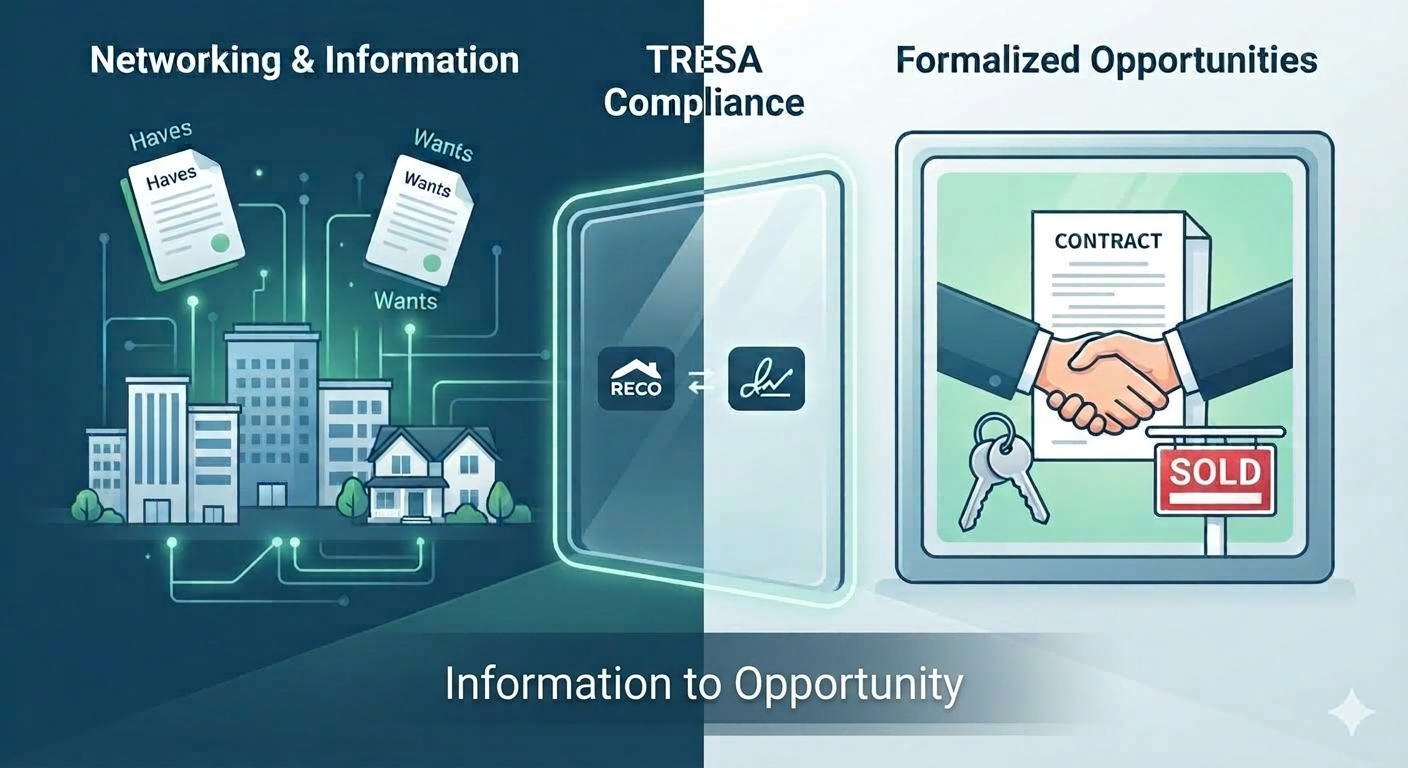
Official Compliance Guide

TRESA Compliance for Real Estate Networking

How to safely manage RECO regulations while maximizing “Have & Want” opportunities on ICIWorld.

Under Ontario’s Trust in Real Estate Services Act (TRESA) administered by the Real Estate Council of Ontario (RECO), navigating early-stage communication is a critical skill. Missteps can inadvertently trigger an implied representation agreement, putting registrations and commissions at risk. This guide clarifies exactly where communication boundaries sit.


🔎 The Three Boundaries of “Just Talking”

TRESA eliminates the historical, ambiguous “customer” category. Every individual an agent interacts with must fit into one of three strict legal buckets:

1. General Consumer Interaction

Answering factual inquiries regarding general market trends, local average pricing, or processing mechanics. Individuals remain consumers until they choose to pursue a targeted transaction.

2. Self-Represented Party (SRP) Trigger

Triggered when an unrepresented individual initiates actions to complete a specific transaction (e.g., requesting a home showing or preparing an offer). Agents must deliver the mandatory RECO Information Guide and secure an SRP Acknowledgment form prior to providing auxiliary assistance.

3. The Client Trigger

Required when individuals request tailored advice, professional opinions, negotiation support, or advocate services. This relationship demands a formal, written representation agreement.


📊 Quick Reference: Permitted vs. Prohibited Actions

Scenario ✅ Compliant Actions ⚠️ Non-Compliant Risks
Casual Dialogue & Networking Providing raw market statistics, generic pricing parameters, and listing process summaries. Formulating professional opinions on asset valuations, advising on structural offering strategies, or guiding decisions.
Handling “Shopping” Prospects Logging unlisted “Haves & Wants” high-level parameters shared across multiple networks. Conducting deep-dive screenings or assessing specific site locations without supplying disclosures.
Unlisted Opportunities (ILS) Utilizing anonymous information parameters on ICIWorld to spark market interest. Releasing identifying file contents, specific locations, or proprietary financial documentation casually.

💡 Managing the “Multi-Agent” Wish List

When a buyer outlines their search parameters (budget, structural requirements, target zones) to multiple industry professionals, they are transacting general criteria as a consumer. Hearing these preferences does not breach guidelines.

The threshold for compliance infractions depends entirely on your response style. Do not analyze specific properties or voice valuation arguments until you introduce official disclosures. Use the scenario to position yourself as an exclusive advisor.


🗒 The Conversion Script: Info Lead to Client

When an inbound inquiry targets an anonymous ICIWorld opportunity, seamlessly transition from information-sharing to a contract framework with this logic model:

“I would love to unlock the confidential file, address routing, and underwriting data for this unlisted opportunity!

However, Ontario’s TRESA guidelines require me to review the official RECO Information Guide with you before disclosing proprietary properties. This step guarantees your legal interests remain fully protected. Let’s allocate ten minutes to review the guide, outline an exclusive single-property agreement, and safely open this portfolio asset for you.”

✨ The 48-Hour Property-Specific Solution


To secure prospects reluctant to execute broad, multi-month exclusive commitments, deploy a targeted 48-hour single-property representation agreement via OREA Form 300 (Buyer) or OREA Form 346 (Tenant):
📅 Precise 48-Hour Term Constraints
Coordinate the commencement timestamp to active execution time. Scale the expiration parameter to precisely 48 hours out. Agreements under 6 months bypass mandatory separate date-initial box criteria under RECO rules.


📌 Narrowly Scoped Geographic Phrasing
Never leave regional settings wide or category-dependent. Insert explicit constraints into the geographic definitions: “Exclusively restricted to the single property known municipally as [Insert Street Address, City, ON].”


📈 Retained Holdover Safeguards
Incorporate standard holdover frameworks (typically 30 to 90 days) restricted to the identified location. This safeguards commission rights if the buyer initiates direct seller bypass strategies once the 48-hour term concludes.

📋 Compliant Digital Signature Delivery Sequence:
1. RECO Information Guide Sign-Off Acknowledgment → 2. Property-Specific OREA Form 300/346 → 3. Confidentiality / Asset NDA Schedules.

© 1994 – 2026 ICIWorld.com • The Association of Real Estate Brokers and Salespeople.
Global Search Commercial and Residential Real Estate Information Listing Service (ILS).


TRESA Compliance for Real Estate Networking: Haves, Wants, and “Just Talking”

How to safely navigate RECO regulations while maximizing your networking opportunities on ICIWorld.

Under the Trust in Real Estate Services Act (TRESA) and RECO guidelines, casual consumer interactions differ from formal client relationships or self-represented parties (SRP). The full HTML code containing detailed compliance boundaries, comparison tables, scripts, and short-duration agreement configurations can be found in the referenced web document.

Brought to you by ICIWorld.com.


TRESA Compliance for Real Estate Networking: Haves, Wants, and “Just Talking”

How to Transition “Haves and Wants” Information Into Committed Clients Under TRESA


  • Can just talking to someone about real estate get you in trouble?

    Real Estate Council of Ontario and Tresa: If you just talk to someone, what is that considered? The reason I ask is that TRESA seems to want to categorize everyone as either an unrepresented person or a client. Just talking to someone can get you in trouble.

    Under the Trust in Real Estate Services Act (TRESA), administered by the Real Estate Council of Ontario (RECO), simply talking to someone is generally considered to be interacting with a “consumer” rather than a client or a self-represented party (SRP). [1]
    However, you are completely right to be cautious. The reason the industry is so strict about these interactions is the massive risk of creating an implied representation agreement. In Ontario, you do not need a signed contract to get into legal trouble; a representation agreement can be legally implied just by how you behave and what you say. [2]

    The Three Boundaries of “Just Talking”

    To keep yourself out of trouble, you have to know exactly where general conversation ends and regulated territory begins:
     
    • General Consumer Interaction: If someone asks you general questions about the local real estate market, average prices in a neighborhood, or how the buying process works, they are just a consumer. You are allowed to answer these questions factually. [1, 3, 4]
    • The Self-Represented Party (SRP) Trigger: The moment a person decides to pursue a specific transaction (e.g., they want to write an offer on your listing or have you show them a home as an unrepresented buyer), they officially cross the line into an SRP. At this point, you must provide them with the mandatory RECO Information Guide and have them sign the SRP Acknowledgment and Consent form before you can give them any further assistance. [4, 5]
    • The Client Trigger: If they want you to act in their best interests, negotiate on their behalf, or guide their decision-making, they must become a Client by entering into a written representation agreement. [6, 7]

    How “Just Talking” Can Get You in Trouble

    TRESA explicitly banned the old, vague “customer” status because agents frequently crossed ethical lines by giving advice to people they didn’t officially represent. Under current rules, you can cross into an illegal implied agreement if you provide any of the following to a non-client: [2, 8, 9]
     
    • Giving opinions or advice (e.g., telling someone, “I think this house is overpriced; you should offer $X” instead of just providing raw market stats).
    • Exercising judgment or discretion on their behalf.
    • Advocating for them or acting as a negotiator in a deal. [2, 4]

    If you do those things without a signed Client agreement, you are in violation of RECO compliance. Even worse, if you give that advice to an unrepresented buyer while you represent the seller, you have inadvertently entered into an illegal, undisclosed multiple-representation situation. [2, 10, 11]

    How to Protect Yourself

    When you are “just talking” to members of the public (like at an open house or a social gathering), stick strictly to impartial, raw facts. The moment the conversation turns toward a specific property, or they ask for your professional opinion on what they should do, stop the conversation and say: [3]
    “Under Ontario law, I need to provide you with a RECO Information Guide before we can dive into those kinds of details, so you understand exactly how real estate relationships work here.” [12, 13]

    Are you trying to manage a specific scenario right now—like handling an open house guest who refuses to sign anything, or figuring out how to talk to an FSBO (For Sale By Owner) seller? Let me know the context so I can give you the exact compliant approach.


    [1] https://unitedrealty.c21.ca
    [2] https://www.reco.on.ca
    [3] https://www.reco.on.ca
    [4] https://soandco.ca
    [5] https://kpbooksco.com
    [6] https://www.realtics.ca
    [7] https://www.exampass.ca
    [8] https://www.paulrushforth.com
    [9] https://realestatemagazine.ca
    [10] https://www.kwlaw.net
    [11] https://www.realtics.ca
    [12] https://www.getwhatyouwant.ca
    [13] https://quinteliving.com

  • Answering Yes to the previous queston at the end.
    If someone says I want to buy a property in a certain area in a price range and lets you know what they want, by the way they say this to multiple agents, does that get you into trouble? Should we tell lthem to shut up?

    No, you do not need to tell them to “shut up,” and hearing that basic information will not get you into trouble. [1]
    When a person tells you (and other agents) their budget, what type of property they want, and the neighborhood they like, they are providing general criteria, not confidential strategic data. Under TRESA regulations, a person sharing high-level, generic search criteria is simply a consumer. [1, 2, 3]
    The line that gets an agent into trouble isn’t what the consumer says to you—it is how you respond. [1, 3]

    Why You Don’t Have to Panic

    Receiving a wish list does not automatically trigger an implied agreement or an SRP (Self-Represented Party) status. TRESA explicitly allows you to provide general information to the public without entering a regulated relationship. [1, 2, 4]
    • You can safely say: “Got it. Detached homes in that neighborhood usually run between $800k and $900k right now, and property taxes average around $4,500.” (This is raw, factual market data). [1, 4]
    • You cannot safely say: “Oh, I know that area well. You should look at 123 Main Street, but don’t pay more than $820k for it because the roof is old.” (The moment you apply your professional judgment, advice, or opinion, you have crossed into an illegal implied representation agreement). [1, 3]

    The Danger of the “Shopping Around” Buyer

    The reason this buyer is telling multiple agents the exact same thing is likely because they are trying to “shop” for an agent, or they mistakenly think that blast-emailing five different realtors will get them a deal faster. [5]
    The risk here isn’t a TRESA violation on day one; the risk is wasting your time or getting dragged into a commission dispute later if they buy a house they found through someone else. [5]

    How to Professionally Take Control

    Instead of telling them to shut up, use TRESA as a tool to filter them out and protect your time. The next time a consumer blasts you with their buying criteria, pivot immediately to the rules: [6]
    “Thanks for sharing what you’re looking for! In Ontario, the real estate rules are very strict about how agents can help buyers. Before I can screen specific listings for you or give you my professional opinion on prices in that area, Ontario law requires me to share the RECO Information Guide with you. Let’s sit down for 10 minutes so I can explain how I protect my clients, and we can see if it makes sense to work together.” [6, 7]
    If they refuse to look at the RECO Information Guide or commit to you, walk away. They want the benefits of a client relationship without giving you the contractual loyalty, and under TRESA, that is exactly what will get an agent fined.
    Are you dealing with someone who is actively sending you listings asking “what do you think of this one?”, or are they just a casual contact dropping their wish list in conversation?

    [1] https://www.reco.on.ca
    [2] https://unitedrealty.c21.ca
    [3] https://www.teamadmiral.com
    [4] https://www.ontario.ca
    [5] https://www.realtor.com
    [6] https://www.paulrushforth.com
    [7] https://www.exampass.ca
  • ICIWorld.com We network real estate Have and Want information for 32 years.. Here is our blog iciworld.blog
    ICIWorld.com We network real estate Have and Want information for 32 years.. Here is our blog iciworld.blog
    That makes perfect sense, and it connects the dots for this conversation. Platforms like ICIWorld.com are built exactly on the concept of discovering real estate opportunities through the networking of general information (Haves and Wants). [1, 2]
    As highlighted on the ICIWorld Blog, every great real estate deal usually starts with a simple conversation—like an owner casually mentioning they might sell if the right buyer comes along, or a buyer stating their budget and preferred location. [3]

    How TRESA Aligns with “Haves and Wants” Networking

    TRESA is designed for consumer protection, not to stop professionals from doing business or having conversations. Looking at the networking model through a TRESA lens clarifies how to manage these boundaries seamlessly: [4]
    • Sharing a “Have” or a “Want” is General Information: When a consumer shares a “Want” (e.g., “I’m looking for a commercial strip mall in Hamilton under $3M”), they are sharing general criteria, not confidential strategic data. On an Information Listing Service (ILS) like ICIWorld, this raw data is simply used to spark a connection. It does not make them a client, and it does not mean you have to stop the conversation. [1, 2, 5]
    • The Transition Point: The TRESA rules only require formalized steps (like the RECO Information Guide or Self-Represented Party disclosures) when you transition from networking information to facilitating a specific transaction. [1]

    The Bottom Line

    You do not need to tell people to shut up when they share their “Haves” and “Wants.” Sharing that data is the lifeblood of real estate networking and opportunity discovery. [1, 4]
    The trick is simply maintaining that clear boundary: use the initial information to find the opportunity, and then put the proper TRESA-compliant disclosures or representation agreements in place before you step into the actual transaction. [1, 6]
    Are you currently utilizing Haves and Wants networking on ICIWorld for commercial or residential opportunities, and would you like to map out the exact script to transition an information-sharing contact into a committed client when an opportunity matches?

    [1] https://iciworld.com
    [2] https://iciworld.com
    [3] https://iciworld.com
    [4] https://iciworld.com
    [5] https://iciworld.com
    [6] https://iciworld.com

  • Transitioning an "Information Lead" into a Committed Client
    Transitioning an “Information Lead” into a Committed Client

    ➡️ Transitioning an “Information Lead” into a Committed Client

    Platforms like ICIWorld are ideal for uncovering hidden opportunities because they leverage anonymous, unlisted Haves and Wants data. Under TRESA rules, sharing or reading this raw, generalized information is entirely compliant. [1, 2, 3]
    The risk only arises when an inquiring party asks you to act on that information. The moment a consumer says, “Tell me more about that confidential $3M strip mall you posted,” or “Can you show me that property?” you must immediately implement a compliant transition strategy. [4]

    🗒 The Compliance Script: General Info to Written Agreement

    When a prospect contacts you regarding an ICIWorld posting, use this exact logical flow to stay fully compliant with RECO guidelines: [1, 5]
    [ Step 1: Acknowledge & Validate ]
    "I would love to give you the details on that unlisted opportunity!"
     │
     ▼
    [ Step 2: Introduce TRESA Boundaries ]
    "Before I can unlock the confidential file, addresses, or financials, Ontario's TRESA laws require me to review the RECO Information Guide with you."
     │
     ▼
    [ Step 3: Present the Choice ]
    "To get this data and have me negotiate on your behalf, we need to quickly set up a Client Representation Agreement so your interests are legally protected."
     │
     ▼
    [ Step 4: The Core Pivot ]
    "Let’s review the guide together right now so I can legally open this file for you."
    

    🔎 Why This Strategy Works

    • Protects Confidentiality: Since ICIWorld listings omit identifying details (like the property address), you hold the leverage. You cannot give away specific details without a written agreement, satisfying both RECO privacy rules and your own commission safety. [2, 5, 6]
    • Bypasses Implied Representation: By stopping the conversation to present the RECO Information Guide, you legally document that you are not offering opinions or advice before a formal relationship is established. [1, 4]
    • Filters Wasted Time: If a consumer refuses to review the guide or commit to a client relationship, they are simply trying to bypass the system. TRESA makes it easy to walk away guilt-free. [6, 7]
    Would you like a specific script tailored for commercial investors who might be more hesitant to sign exclusive paperwork, or do you need a template to send out along with the digital RECO Information Guide link?

    [1] https://www.reco.on.ca
    [2] https://iciworld.com
    [3] https://iciworld.com
    [4] https://www.facebook.com
    [5] https://iciworld.com
    [6] https://www.reco.on.ca
    [7] https://unitedrealty.c21.ca
  • would like to ha;ve an agreement to show one property within a 48 hour time period.
    would like to ha;ve an agreement to show one property within a 48 hour time period.

    Yes, you can absolutely do that. Writing a property-specific, short-duration representation agreement is a brilliant, highly compliant way to handle an “information lead” under TRESA. [1]
    It gives a skeptical buyer or investor a zero-risk way to see that ICIWorld opportunity while legally protecting your commission and fulfilling your RECO obligations. [1, 2]
    A standard OREA Form 300 (Buyer Representation Agreement) or OREA Form 346 (Tenant Representation Agreement) can be scoped down to lock in these exact constraints. [3, 4]

    ✍️ How to Fill Out the Agreement for a 48-Hour Single Property

    To narrow the scope so it applies only to that specific property for 48 hours, ensure these three fields are explicitly defined:
    1. The Term (Duration):
      • Commencement Date: Set it to start right now.
      • Expiry Date: Set it to expire exactly 48 hours from now. (Note: Under RECO rules, any agreement lasting less than 6 months does NOT require a separate initials acknowledgment for the date, making this quick and seamless). [4, 5]
    2. Property Type & Geographic Location:
      • Instead of writing something broad like “Commercial Retail in Hamilton,” write the exact property address or legal description.
      • Example wording: “Single property known municipally as 123 Main Street, Hamilton, ON.” [5, 6]
    3. The Holdover Clause:
      • Remember that the holdover clause (usually 30 to 90 days) will still apply to this specific property. This protects you if they wait for your 48-hour window to close and then try to loop back to the seller directly behind your back. [5, 7]

    💬 The “No-Pressure” Script to Get It Signed

    Many commercial investors or casual buyers shy away from broad, 6-month exclusive agreements. Presenting this 48-hour, single-property document lowers their guard because it feels like a fair exchange for your data:
    “I completely understand you don’t want to lock yourself into a long-term contract right now. To protect everyone and stay compliant with Ontario’s TRESA laws, we can use a property-specific agreement. [1]
    This agreement is only valid for 48 hours and applies exclusively to 123 Main Street. It doesn’t tie you to me for any other properties or any future deals. It simply allows me to legally open this specific confidential file, share the financials, and represent your interests if you choose to move forward on it today.” [2, 5, 7, 8]

    🛠 Your Pre-Flight Checklist

    Before you send the electronic signature link over, verify that you have executed these two actions:
    • Sent and explained the mandatory digital RECO Information Guide.
    • Obtained their signed acknowledgment of the guide (this can be done simultaneously with your 48-hour agreement). [6, 9]
    Are you setting this up for a commercial purchase (Form 300) or a commercial lease (Form 346), and do you need help drafting a specific confidentiality/non-disclosure clause to attach as a schedule?

    [1] https://waltermonteiro.remaxrecentre.ca
    [2] https://premierottawa.ca
    [3] https://forms.runsensible.com
    [4] https://helpingyoubuildwealththroughrealestate.buzzsprout.com
    [5] https://pdfliner.com
    [6] https://www.youtube.com
    [7] https://treadstonelaw.ca
    [8] https://www.reco.on.ca
    [9] https://www.facebook.com
  • the answers on this page are they from google, google chrome or ai?
    Executing a 48-hour property-specific agreement once you have an active buyer is an excellent, compliant strategy. Under TRESA guidelines, it formalizes a Client relationship with zero long-term friction. [1, 2]
    To lock this in correctly using OREA Form 300 (Buyer Representation Agreement) or OREA Form 346 (Tenant Representation Agreement), apply these exact fields: [1]

    1. The Time Limit (48 Hours)

    • Commencement: Set the start date and exact time to right now.
    • Expiry: Set the date and time to exactly 48 hours from the commencement time.
    • TRESA Compliance Bonus: Because this agreement is under 6 months in duration, the buyer does not need to sign the separate, mandatory “initials box” required for long-term contracts. This makes the digital signing process rapid and seamless. [3, 4]

    2. The Property Type & Geographic Location (The Narrow Scope)

    Do not leave this broad. If you write “Hamilton” or “Commercial Property,” you legally lock them into you exclusively for all properties in that category. Instead, scope it explicitly to the ICIWorld address. [4]
    • Property Type: Commercial / Investment (or Residential Resale, depending on the asset).
    • Geographic Location: Use the exact phrasing: “Exclusively restricted to the single property known municipally as [Insert Street Address, City, ON].” [4]

    3. The Holdover Period (Your Legal Safety Net)

    • Set a holdover period (typically 30 to 90 days).
    • Why this matters: If your 48-hour window expires, and the buyer loops back to the seller 10 days later to cut you out of the deal, the holdover clause legally guarantees that you are still owed your commission because you introduced the property during the agreement window. [3, 4, 5]

    📥 The Electronic Signature Package

    When you send this to your buyer over your electronic signature platform, the signing envelope must include these documents in this specific order to satisfy a RECO audit:
    1. RECO Information Guide: The consumer must sign the acknowledgment page confirming they received and read the guide before or at the same time they sign the representation agreement.
    2. OREA Form 300 / 346: Scoped to the 48 hours and specific address. [1]
    3. Confidentiality / NDA Schedule (If applicable): If the ICIWorld listing requires a non-disclosure agreement to release financial statements or rent rolls, append it as a Schedule to Form 300.
    Would you like me to generate the exact legal text for the “Property Scope” and “Holdover Clause” so you can paste it directly into your OREA software, or do you need a quick email template to send to the buyer explaining why you are structuring it this way?

    [1] https://forms.runsensible.com
    [2] https://kpbooksco.com
    [3] https://www.youtube.com
    [4] https://pdfliner.com
    [5] https://instafill.ai
  • 48-hur property agreement once I have a buyer.
    Executing a 48-hour property-specific agreement once you have an active buyer is an excellent, compliant strategy. Under TRESA guidelines, it formalizes a Client relationship with zero long-term friction. [1, 2]
    To lock this in correctly using OREA Form 300 (Buyer Representation Agreement) or OREA Form 346 (Tenant Representation Agreement), apply these exact fields: [1]

    1. The Time Limit (48 Hours)

    • Commencement: Set the start date and exact time to right now.
    • Expiry: Set the date and time to exactly 48 hours from the commencement time.
    • TRESA Compliance Bonus: Because this agreement is under 6 months in duration, the buyer does not need to sign the separate, mandatory “initials box” required for long-term contracts. This makes the digital signing process rapid and seamless. [3, 4]

    2. The Property Type & Geographic Location (The Narrow Scope)

    Do not leave this broad. If you write “Hamilton” or “Commercial Property,” you legally lock them into you exclusively for all properties in that category. Instead, scope it explicitly to the ICIWorld address. [4]
    • Property Type: Commercial / Investment (or Residential Resale, depending on the asset).
    • Geographic Location: Use the exact phrasing: “Exclusively restricted to the single property known municipally as [Insert Street Address, City, ON].” [4]

    3. The Holdover Period (Your Legal Safety Net)

    • Set a holdover period (typically 30 to 90 days).
    • Why this matters: If your 48-hour window expires, and the buyer loops back to the seller 10 days later to cut you out of the deal, the holdover clause legally guarantees that you are still owed your commission because you introduced the property during the agreement window. [3, 4, 5]

    📥 The Electronic Signature Package

    When you send this to your buyer over your electronic signature platform, the signing envelope must include these documents in this specific order to satisfy a RECO audit:
    1. RECO Information Guide: The consumer must sign the acknowledgment page confirming they received and read the guide before or at the same time they sign the representation agreement.
    2. OREA Form 300 / 346: Scoped to the 48 hours and specific address. [1]
    3. Confidentiality / NDA Schedule (If applicable): If the ICIWorld listing requires a non-disclosure agreement to release financial statements or rent rolls, append it as a Schedule to Form 300.
    Would you like me to generate the exact legal text for the “Property Scope” and “Holdover Clause” so you can paste it directly into your OREA software, or do you need a quick email template to send to the buyer explaining why you are structuring it this way?

    [1] https://forms.runsensible.com
    [2] https://kpbooksco.com
    [3] https://www.youtube.com
    [4] https://pdfliner.com
    [5] https://instafill.ai
Back To Top
ICIWorld.com Global Commercial and Residential Real Estate Networking and Information Listing Service (ILS)

18 King St. E., Suite 1400
Toronto, Ontario, Canada
M5C 1C4
416-840-6227
416-214-4875

USA
954-317-2327

  • linkedIN
  • Facebook
  • Twitter
  • YouTube

What the mind of man can conceive and believe he can achieve.

- Napoleon Hill
The ICIWorld Association of Real Estate Brokers and Salespeople Founded 1994.