NOTE: UNDER CONSTRUCTION FROM GN: Saturday, September 19, 2026. Adding content to this page. Will reformat it later in the week. All feedback on this and all services is always appreciated. And if you find any mistakes, please let us know.
TRESA Compliance for Real Estate Networking: Haves, Wants, and “Just Talking.”
ICIWorld helps you do it all, but check with your manager or broker of record for all compliance issues.
Show them this page.
Please consult with us if there is any issue.
We too are learning to share knowledge to help our members stay compliant.
ICIWorld since 1994.
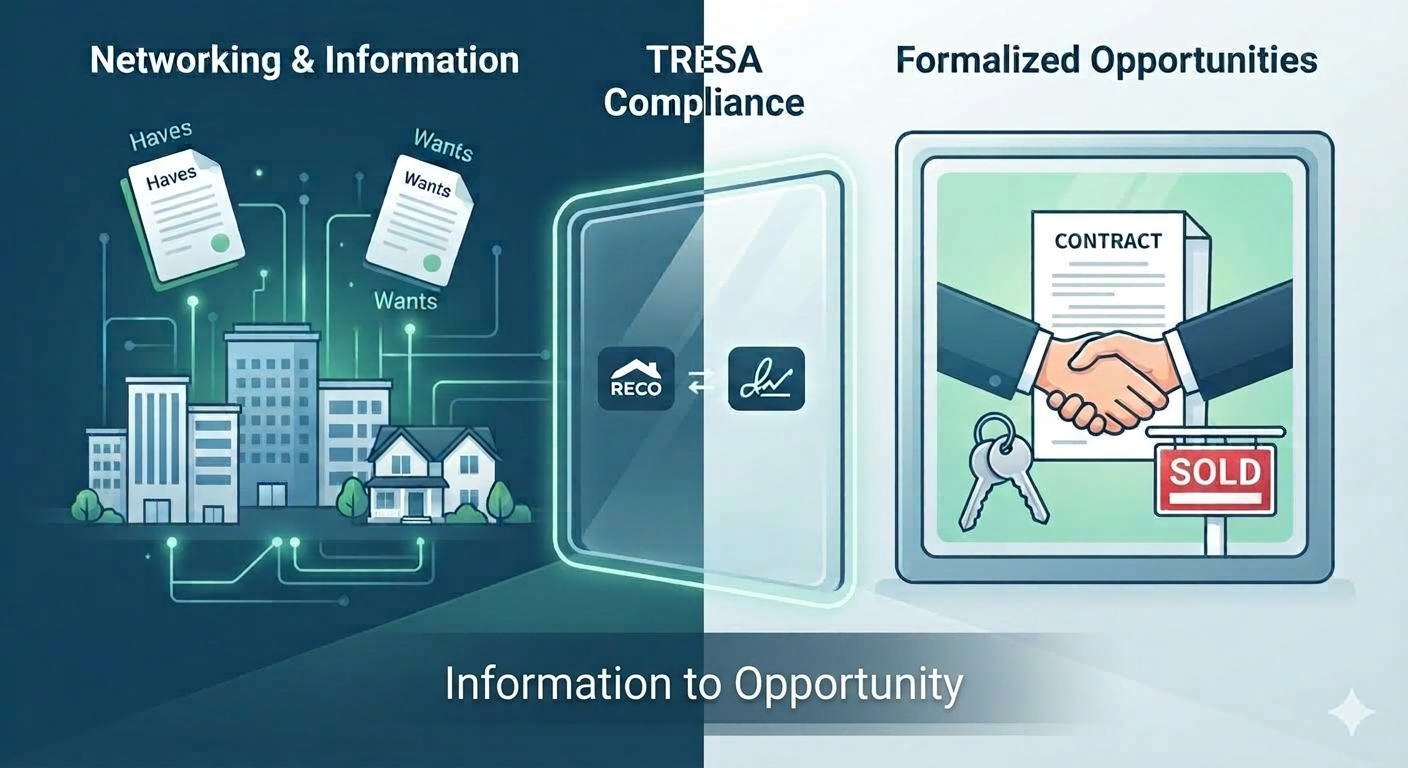
TRESA Compliance for Real Estate Networking
How to safely manage RECO regulations while maximizing “Have & Want” opportunities on ICIWorld.
Under Ontario’s Trust in Real Estate Services Act (TRESA) administered by the Real Estate Council of Ontario (RECO), navigating early-stage communication is a critical skill. Missteps can inadvertently trigger an implied representation agreement, putting registrations and commissions at risk. This guide clarifies exactly where communication boundaries sit.
🔎 The Three Boundaries of “Just Talking”
TRESA eliminates the historical, ambiguous “customer” category. Every individual an agent interacts with must fit into one of three strict legal buckets:
1. General Consumer Interaction
Answering factual inquiries regarding general market trends, local average pricing, or processing mechanics. Individuals remain consumers until they choose to pursue a targeted transaction.
2. Self-Represented Party (SRP) Trigger
Triggered when an unrepresented individual initiates actions to complete a specific transaction (e.g., requesting a home showing or preparing an offer). Agents must deliver the mandatory RECO Information Guide and secure an SRP Acknowledgment form prior to providing auxiliary assistance.
3. The Client Trigger
Required when individuals request tailored advice, professional opinions, negotiation support, or advocate services. This relationship demands a formal, written representation agreement.
📊 Quick Reference: Permitted vs. Prohibited Actions
| Scenario | ✅ Compliant Actions | ⚠️ Non-Compliant Risks |
|---|---|---|
| Casual Dialogue & Networking | Providing raw market statistics, generic pricing parameters, and listing process summaries. | Formulating professional opinions on asset valuations, advising on structural offering strategies, or guiding decisions. |
| Handling “Shopping” Prospects | Logging unlisted “Haves & Wants” high-level parameters shared across multiple networks. | Conducting deep-dive screenings or assessing specific site locations without supplying disclosures. |
| Unlisted Opportunities (ILS) | Utilizing anonymous information parameters on ICIWorld to spark market interest. | Releasing identifying file contents, specific locations, or proprietary financial documentation casually. |
💡 Managing the “Multi-Agent” Wish List
When a buyer outlines their search parameters (budget, structural requirements, target zones) to multiple industry professionals, they are transacting general criteria as a consumer. Hearing these preferences does not breach guidelines.
The threshold for compliance infractions depends entirely on your response style. Do not analyze specific properties or voice valuation arguments until you introduce official disclosures. Use the scenario to position yourself as an exclusive advisor.
🗒 The Conversion Script: Info Lead to Client
When an inbound inquiry targets an anonymous ICIWorld opportunity, seamlessly transition from information-sharing to a contract framework with this logic model:
However, Ontario’s TRESA guidelines require me to review the official RECO Information Guide with you before disclosing proprietary properties. This step guarantees your legal interests remain fully protected. Let’s allocate ten minutes to review the guide, outline an exclusive single-property agreement, and safely open this portfolio asset for you.”
To secure prospects reluctant to execute broad, multi-month exclusive commitments, deploy a targeted 48-hour single-property representation agreement via OREA Form 300 (Buyer) or OREA Form 346 (Tenant):
Coordinate the commencement timestamp to active execution time. Scale the expiration parameter to precisely 48 hours out. Agreements under 6 months bypass mandatory separate date-initial box criteria under RECO rules.
📌 Narrowly Scoped Geographic Phrasing
Never leave regional settings wide or category-dependent. Insert explicit constraints into the geographic definitions: “Exclusively restricted to the single property known municipally as [Insert Street Address, City, ON].”
📈 Retained Holdover Safeguards
Incorporate standard holdover frameworks (typically 30 to 90 days) restricted to the identified location. This safeguards commission rights if the buyer initiates direct seller bypass strategies once the 48-hour term concludes.
1. RECO Information Guide Sign-Off Acknowledgment → 2. Property-Specific OREA Form 300/346 → 3. Confidentiality / Asset NDA Schedules.
Global Search Commercial and Residential Real Estate Information Listing Service (ILS).
TRESA Compliance for Real Estate Networking: Haves, Wants, and “Just Talking”
How to safely navigate RECO regulations while maximizing your networking opportunities on ICIWorld.
Under the Trust in Real Estate Services Act (TRESA) and RECO guidelines, casual consumer interactions differ from formal client relationships or self-represented parties (SRP). The full HTML code containing detailed compliance boundaries, comparison tables, scripts, and short-duration agreement configurations can be found in the referenced web document.